
Last Updated: November 5, 2026
Quick Summary
Managing construction site risks means running one repeatable loop: identify hazards, assess them by likelihood and impact, control them through the hierarchy of controls, document them in a risk management plan, and monitor controls on site. Most site failures come from ordinary risks nobody wrote down, so continuous reassessment matters more than paperwork.
- Score each hazard by likelihood and impact on a 1-5 scale, then multiply for a priority ranking.
- Work down the hierarchy of controls in order and use PPE only as the last line of defence.
- A safe work method statement should be task-specific and kept on site for high-risk work.
- Track leading indicators such as inspection completion rate and corrective-action closure time.
- Reassess the register after weather shifts, new subcontractors, design changes or changed site conditions.
Table of Contents
- A Repeatable Process for Managing Construction Site Risks
- Step 1: Identifying Hazards and Project Risks
- Step 2: Running a Construction Site Risk Assessment
- Step 3: Controlling Risks Through the Hierarchy of Controls
- Step 4: Building a Construction Risk Management Plan
- Step 5: Safe Work Method Statements and Site Documentation
- Step 6: Using a Construction Site Safety Checklist and Monitoring Controls
- Where Insurance Fits in Your Construction Site Risks Strategy
- Frequently Asked Questions
A Repeatable Process for Managing Construction Site Risks
Construction site risks are the hazards, project threats and commercial exposures that can injure workers, damage property or derail a build.
Most site failures are not caused by exotic hazards. They come from ordinary risks nobody wrote down. A missing risk register. A subcontractor who was never inducted.
Below, we break the process into six steps you can run on any project, from a single trade job to a multi-stage build.
Step 1: Identifying Hazards and Project Risks
Hazard identification means listing everything on site that could cause harm, plus the project risks that could hurt the build. Do this before work starts and refresh it as the site changes.
Walk the site with the people who do the work. They spot things a desk review misses. Cover both sides of the ledger:
- Health and safety hazards: work at height, excavation, plant and equipment, hazardous materials, electrical, manual handling
- Project risks: cost overrun, schedule delay, quality defects, subcontractor failure, supply shortages
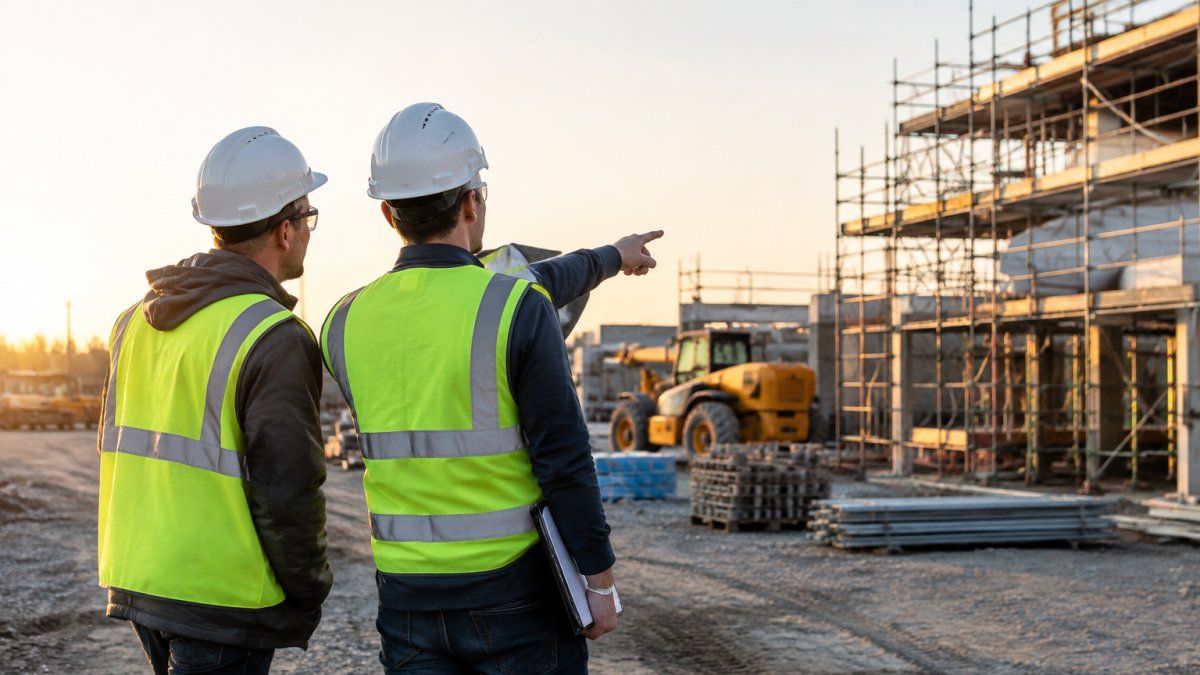
A common mistake is treating this as a one-off paperwork exercise. In practice, hazard identification is continuous. New trades arrive, weather shifts, and the risk picture changes.
Step 2: Running a Construction Site Risk Assessment
A construction site risk assessment scores each identified hazard by likelihood and impact, so you can rank risks and focus controls where they matter most. It turns a long hazard list into a clear priority order.
Run it in four moves:
- Take each hazard from your register.
- Rate how likely it is to cause harm.
- Rate the severity of that harm.
- Multiply the two to get a risk ranking.
Rating Likelihood, Impact and Risk Priority
Use a simple scale. Rate likelihood from rare to almost certain, and impact from minor to severe. A 1-5 scale for each is enough for most sites. Multiply them for a priority score, then sort high to low.
| Likelihood | Impact | Priority | Action |
|---|---|---|---|
| High | Severe | Critical | Stop work, control now |
| High | Minor | High | Control before next shift |
| Low | Severe | High | Control and monitor closely |
| Low | Minor | Low | Monitor and review |
A Worked Example: Completed Risk Register Entries
Abstract scales only become useful when they are applied to real tasks. The example below shows how three common construction activities would be entered in a risk register before controls are applied.
| Task | Hazard | Likelihood (1-5) | Impact (1-5) | Score | Priority |
|---|---|---|---|---|---|
| Roof sheeting | Fall from height | 4 | 5 | 20 | Critical |
| Trenching for services | Excavation collapse | 3 | 5 | 15 | High |
| Mobile plant movement | Pedestrian struck by plant | 3 | 4 | 12 | High |
| Manual handling of formwork | Musculoskeletal injury | 4 | 2 | 8 | Medium |
| Hazardous substance use | Chemical exposure | 2 | 3 | 6 | Low |
Once controls are selected in Step 3, the same register should record the residual score, the risk remaining after controls, so the team can see whether the control has actually reduced the risk to an acceptable level.
A job hazard analysis (JHA) is the task-level companion to the register.
Getting the Ratings Right
Two failure modes are common. The first is scoring everything as high, which flattens the priority order and makes the register useless for deciding where to spend control effort. The second is scoring by paperwork rather than by what the site actually looks like on the day.
Watch out: if every risk on your register comes out as critical, the scale is being applied without discrimination, recalibrate against the definitions of each rating level before the register is used to allocate controls.
For larger or higher-risk work, our risk management service helps identify and reduce the risks that could disrupt your business.
Step 3: Controlling Risks Through the Hierarchy of Controls
The hierarchy of controls ranks risk controls from most to least effective.
- Eliminate the hazard, for example prefabricating off site to remove work at height
- Substitute a hazardous task with a safer one
- Engineering controls, such as guardrails and excavation shoring
- Administrative controls, such as safe work method statements and training
- Personal protective equipment, such as harnesses and helmets
The mistake is jumping straight to PPE. It protects the individual but does nothing to remove the hazard. Control the risk at the source first, then layer PPE on top.
Worker-related risks deserve the same discipline. A safe, well-managed workplace is one of the most effective ways to cut business risk, and our workers compensation services support that goal.
Step 4: Building a Construction Risk Management Plan
A construction risk management plan is the written record of your risks, controls, owners and review dates. It turns good intentions into something you can audit and hand to a client or insurer.
A workable plan covers:
- The project scope and key stakeholders
- Your risk register, with likelihood, impact and priority
- The control measures for each risk
- Who owns each risk and each control
- Your review schedule and escalation process
- How you will respond to incidents
Formalising risk allocation in contracts matters too. Our contract review services help you spot risks before you sign.
Step 5: Safe Work Method Statements and Site Documentation
A safe work method statement sets out how a high-risk task will be done safely, step by step.
For high-risk construction work, a safe work method statement is a standard part of site documentation. Keep it task-specific and on site.
Pair each statement with:
- A current risk register
- Site induction records
- Plant and equipment inspection logs
- Incident and near-miss reports
Good documentation does two things. It keeps workers safe, and it gives your insurer a clear picture of how you manage risk when a claim arises.
Step 6: Using a Construction Site Safety Checklist and Monitoring Controls
A construction site safety checklist is a short, repeatable list you run on site inspections to confirm controls are in place and still working. Monitoring is where most risk management plans quietly fail.
Check the control, not just the paperwork. A guardrail that was installed in week one may be gone by week six. Track leading indicators, not just incidents:
- Are all workers inducted and site rules explained?
- Are high-risk tasks covered by a current safe work method statement?
- Are excavation and work-at-height controls checked this week?
- Are plant and equipment inspections up to date?
- Are near misses logged and reviewed?
- Have controls been checked since the last site change?
Leading Indicators You Can Actually Measure
Incident counts tell you what has already gone wrong. Leading indicators tell you whether your controls are holding before harm occurs. The measures below are practical to track on a weekly site meeting and give the team something to act on rather than a lagging incident tally.
- Inspection completion rate: the proportion of scheduled inspections actually completed on time. A rate below 100% is an early warning that controls are going unchecked.
- Corrective-action closure time: the average number of days between a defect being logged and the control being fixed. Track the oldest open action, not just the average, because a single stale action is often the one that matters.
- Near-miss reporting rate: the number of near misses reported per period. A rising rate can be a good sign, it usually means reporting is working, while a rate that falls to zero often means workers have stopped bothering.
- Control verification rate: the proportion of critical controls (guardrails, shoring, exclusion zones) physically verified during the period, as distinct from assumed to be in place.
- Induction and ticket currency: the proportion of workers on site with current induction, high-risk work tickets and plant licences.
Report these at the same frequency as your progress meetings so that safety performance sits alongside cost and schedule, not in a separate conversation.
Worker Participation and Daily Communication
Monitoring is not a management-only activity. The workers doing the task see changing conditions first, and the monitoring system should give them a route to report what they see.
- Toolbox talks: short, task-specific briefings at the start of a shift that cover the hazards for that day’s work and the controls in place. Keep them specific to the task rather than generic safety reminders.
- Worker consultation: consult the workforce when controls are being selected, not only after an incident. Workers who helped choose a control are more likely to use it.
- Stop-work authority: every worker should know they can stop a task they believe is unsafe without fear of reprisal. This needs to be stated at induction and reinforced by supervisors.
- Reporting changing conditions: give workers a simple route, a verbal report to the supervisor, a near-miss card, or a daily pre-start form, to flag a change in conditions before it becomes an incident.
Dynamic Risks and Change Management
A risk register is a snapshot, and sites change constantly. Reassess when any of the following occurs:
- Weather shifts that affect work at height, excavation stability or crane operations
- A change in work sequencing that puts trades in proximity they were not planned for
- A new subcontractor arrives on site without the induction or task knowledge assumed in the plan
- Site conditions change, such as ground conditions during excavation or services discovered where the drawings did not show them
- A design change alters the method of work
When a change occurs, revisit the relevant register entries, update the safe work method statement if the task is high-risk, brief the affected workers, and record the reassessment. A change that is not written down is a change that will not be controlled.
Emergency Preparedness and Residual Risk
Monitoring should connect back to what happens when a control fails. Confirm that emergency procedures are current for the site layout as it stands today, assembly points, first-aid arrangements, rescue plans for work at height and excavation, and emergency contacts, and that they have been tested or walked through with the workforce.
Residual risk is the risk that remains after controls are applied. It is never zero.
Review your register on a set schedule and after any change. Continuous improvement comes from acting on what the checks find.
Where Insurance Fits in Your Construction Site Risks Strategy
Insurance does not remove a risk. It transfers the financial impact you cannot absorb, which is why it sits alongside your controls, not instead of them. Strong controls lower your risk, and a well-built programme protects you when something still goes wrong.
The right cover depends on your work and your contracts. For the detail, read our guide to construction liability insurance requirements. It explains the cover types and contractual conditions that come up most often.
At Shockwave Insurance Brokers, we combine proactive risk management with personalised, strategic advice. If you want to review an existing policy or discuss a new risk, our team is ready to help. Reach out to a Shockwave broker and let’s get your cover right.
Frequently Asked Questions
What are the main risks on a construction site?
The main construction site risks fall into two groups. Health and safety risks include work at height, excavation collapse, plant and equipment movement, hazardous materials such as silica dust, electrical hazards and manual handling. Project risks include cost overrun, schedule delay, subcontractor default, quality defects and contractual liability. A workable risk register tracks both, because a safety incident usually triggers a schedule and cost problem as well.
How often should construction site risks be reviewed?
Review your risk register at least monthly, and again whenever something changes: a new trade starts, plant arrives on site, weather shifts the programme, or a design variation lands. Daily pre-start meetings catch the short-term changes a monthly review misses. Record the review date and who attended so you can show the process was followed if a regulator or insurer asks for evidence.
What is a safe work method statement and when is one required?
A safe work method statement (SWMS) sets out the high-risk construction work being done, the hazards involved, the control measures and who is responsible. One is required before any high-risk construction work starts, and it must be reviewed and revised if the work changes. Keep it on site, brief the workers who will do the task, and have them sign on so the record shows the controls were communicated.
Who is responsible for managing risks on a construction site?
Responsibility is shared but not equal. The principal contractor or person conducting the business has the primary duty to manage risks so far as is reasonably practicable, and that duty extends to subcontractors and visitors. Workers must follow the controls and report hazards. Document who owns each risk in your risk register, because an unassigned risk is the one that gets missed.
Managing construction site risks is not about a single document. It is about running the same loop every week and acting on what you find. If your current cover was built without a clear view of your site risks, that is worth fixing before a claim tests it. Get started with Shockwave Insurance Brokers and build an insurance programme that matches the way you actually work.